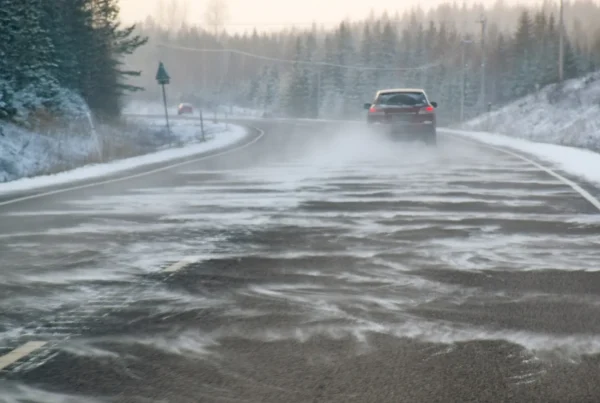
Most people in Lemont didn’t buy all-wheel drive for a sunny Saturday. They bought it because of one bad February morning: a driveway nobody had touched yet, a climb up out of the subdivision toward Archer Avenue, and the feeling of the front tires giving up. AWD fixed that morning, and it has quietly fixed every one since.
Here’s the part almost nobody hears at the dealership. The system that pulled you up that hill isn’t run by your engine oil. It has its own gearboxes, filled with its own oil, and those gearboxes keep a schedule that has nothing to do with the sticker on your windshield.
We’ve been fixing cars in Lemont since 1990, for neighbors here and across the southwest suburbs from Homer Glen and Lockport to Darien and Willow Springs. Driveline fluid is one of the most commonly skipped maintenance items we see, and usually on vehicles that are otherwise well cared for. Owners aren’t being careless. The interval is genuinely hard to find, and on some vehicles the manufacturer says out loud that there isn’t one.
What Actually Gets You Moving in Snow (And What It Runs On)
When a wheel starts spinning on a snow-packed side street, several parts you’ve probably never seen go to work. Each one is a small gearbox, and each one is filled with gear oil, separate from the engine.
The transfer case. On a 4WD pickup or a truck-based SUV, this sits behind the transmission and splits power between the front and rear driveshafts. It’s what actually happens when you turn that dial to 4-Hi.
The power transfer unit, or PTU. On a car-based AWD crossover, the same job gets done by a smaller unit bolted to the side of the transaxle, sending power rearward to a driveshaft that would otherwise not exist. Different name, different packaging, same idea.
The front and rear differentials. These let the wheels on one axle turn at different speeds, which is what makes a turn possible at all. They use hypoid gears, which is why they take a specific heavy gear oil rather than anything else on the shelf.
A clutch pack or coupling. Many AWD systems decide how much torque goes where using a clutch pack, and plenty of pickups have a limited-slip rear differential that uses clutches to send power to the wheel with grip instead of the one spinning. Those clutches live in the oil, and they depend on it behaving in a very specific way.
So on an AWD crossover you may have three separate reservoirs of gear oil in the driveline. On a 4WD pickup, three or four. None of them share the engine’s dipstick, and none of them get touched during a normal oil service.
Why Winter Here Is Harder on Gear Oil Than the Mileage Suggests
Mileage is a poor measure of how hard these parts have worked. What matters is how much of that mileage was spent slipping, crawling and soaked.
The Chicago area averages 38.4 inches of snowfall a year, going by the National Weather Service’s 1991-2020 normals for O’Hare. The scale of the response says as much as the snow total: through April of this past season, the Illinois Department of Transportation reported using more than 357,500 tons of salt, with 1,900 trucks available to cover 45,000 lane miles statewide.
Now bring it down to your street. Lemont’s public works department divides the village into nine snow-and-ice zones and plows in three priority tiers. Primary roads, routes near schools, hills and emergency access come first. Secondary streets follow. Cul-de-sacs and dead ends are the last tier, and the village’s odd-even parking rule kicks in after a snowfall of two inches or more.
That priority list is a maintenance schedule in disguise. If you live on a cul-de-sac off Bell Road, or up in the hills above downtown Lemont, your AWD system spends a real share of every snow event doing the hardest thing you can ask of it: moving a heavy vehicle over packed snow at walking speed, wheels slipping and grabbing, with no highway run afterward to shed the heat. Add road spray full of salt brine, short winter trips that never fully warm the gear oil, and the freeze-thaw potholes that show up on those same streets by March. Two owners with identical odometer readings can end up with driveline fluid in completely different condition.
The Interval Nobody Tells You About
This is where it gets frustrating, so let’s use two real examples from opposite ends of the market.
Chevrolet is specific. The 2025 Silverado HD owner’s manual calls for the transfer case fluid to be replaced every 50,000 miles under normal service, and that interval drops to 25,000 miles under severe service. Same truck, same part, half the interval, based entirely on how it’s driven.
Ford, on some AWD models, takes a different approach. Its own scheduled-maintenance content states plainly that “the Power Transfer Unit (PTU) and rear axle (AWD only) in your vehicle does not require any normal scheduled maintenance.” Read further into the same schedule, though, into the Special Operating Conditions section, and it directs owners to change the PTU and rear axle fluid at 30,000 and 60,000 miles. Those special conditions include towing, extensive idling or low-speed driving, and dusty or sandy conditions. It also flags a change if the unit has been submerged in water or shows signs of leakage, or if the vehicle has seen extended periods of extreme or severe duty-cycle driving.
Both of those are correct, and both belong in the same conversation. There is no universal interval for a transfer case fluid change or for differential fluid. Your manual is the only authority for your vehicle, and the severe-service column is usually the honest one for a winter in the southwest suburbs.
How to Find Your Own Interval Instead of Guessing
You can settle this yourself in about ten minutes, with the glovebox open.
- Find the maintenance schedule, not the operating instructions. It’s usually the back section of the owner’s manual, or a separate scheduled-maintenance booklet. Many manufacturers also publish it free on their owner’s website.
- Look for the parts by name. Search for “transfer case,” “rear axle,” “power transfer unit,” “front differential” and “rear differential.” They are listed separately from the transmission, and often from each other.
- Read whether the entry says inspect or replace. This matters. “Inspect” doesn’t mean glance underneath; it means checking the level and the condition of the fluid, which is a lift-and-sample job.
- Then read the severe or special operating conditions list. Every manufacturer has one. Compare it honestly against your own driving: short trips, trailer towing, idling, plowing, gravel, deep snow, a work truck that never leaves town.
- Write the number down and count from your last service. If nobody has ever touched these fluids and the vehicle has real miles, that answer is already useful.
Can’t find it? Bring the vehicle in and we’ll look it up against your VIN. Getting that number right is where real 4WD maintenance in Lemont starts, and it takes a few minutes at the counter.
Symptoms of Tired Driveline Fluid, and Which Component They Point At
Gear oil rarely fails all at once. It tells on itself first, and the specific complaint usually names the part.
A whine that changes with speed. A steady whine or hum that rises and falls between about 35 and 45 mph, or changes character as you round a curve onto a side street, points at a differential. Gear noise that varies with cornering is a classic tell, because a turn changes exactly which gears are loaded.
A shudder or chatter in a tight circle. Creep around a parking lot at full lock and feel a shudder or hear a rhythmic clunking through the floor, and you’re most likely feeling clutches. In a clutch-type limited-slip differential, the friction modifier in the oil exists to guard against abnormal clutch engagement and disengagement, which is the source of chatter. Situations that demand variable traction, like tight turns, are exactly where a spent additive shows up.
A burnt smell. A sharp, hot, burnt odor after a slow slog home through snow, strongest near the vent housing on top of a gearbox, means the oil has been overheated. Fluid that has turned dark and sludgy rather than reddish or amber tells the same story.
Noise you can’t place, plus a wet spot. Whining, grinding or humming from underneath, or a visible leak beneath the vehicle, both belong on the list. Gear oil weeps from a vent or a seal and leaves a damp, dirty film that collects road grime.
Something that just feels different in snow. Delayed engagement, a light on the dash, or an AWD system that doesn’t grab the way it used to. Worth reporting even if you can’t describe it precisely.
Spec Matters as Much as the Interval
“Gear oil” isn’t one product, and this is where a bargain fluid change can cost you a gearbox.
Differentials with hypoid gears typically call for a GL-5 rated oil, which carries higher levels of sulfur-based additive to survive the extreme pressure at the gear teeth. That same GL-5 oil is incompatible with gearboxes containing soft metal components, which require a milder GL-4 formulation instead. Put the wrong one in and the additive package attacks the parts it’s supposed to protect.
Then there’s the friction modifier question on any clutch-type limited-slip unit, plus the manufacturer’s viscosity call and the capacity. Capacity varies enormously: some of these units hold well under a quart, others hold several. That’s part of why we won’t publish a number for this service. The correct fluid, the correct additive and the correct volume are all vehicle-specific, so the only honest answer on cost is a current quote for your exact vehicle. Ask us for a quote and you’ll have one before any work starts.
What AWD Service in Lemont, IL Looks Like in Our Bay
If you’ve been searching for AWD service near you and wondering what you’re actually buying, here it is. A differential fluid service or a transfer case fluid change at our shop isn’t a drain-and-go:
- Road test first, if there’s a noise. We want to hear it at the speed and in the turn where you hear it, so we’re diagnosing the right component instead of replacing fluid and hoping.
- Inspection on the lift. Case, seals, vent, driveshaft, u-joints, CV boots and mounts. A leaking vent or a weeping pinion seal changes the plan, because new oil in a leaking case buys you very little.
- Check the fluid’s condition, not just its level. Color, smell, and whether there’s metallic glitter or a paste on the drain plug magnet. That’s what “inspect” means in your manual.
- Drain and refill to the manufacturer’s spec and capacity, with the right friction modifier where the unit requires one.
- Tell you what we found. If a differential is already making noise from wear rather than from tired oil, you’ll hear that plainly, along with your options.
Local fleets have a shortcut here: if your trucks and vans match the “extensive idling and low-speed driving” language in the manual, you’re on the severe schedule, full stop. That’s a call you make once and put on a calendar, and it beats triaging a work truck that’s already down on a Monday morning.
Book It Before the First Real Snow
Early fall is the right window. This is scheduled maintenance on its own components, on its own timetable, and it deserves an appointment of its own rather than being tacked onto whatever else happens to be due.
If your AWD crossover or 4WD pickup has never had this work done, or you have no idea when it last happened, that’s the most common situation we see and the easiest to fix. Bring us the vehicle, we’ll pull the correct interval and spec, inspect what’s there, and give you a straight answer along with a current quote.
Schedule an appointment at our shop here in Lemont, and let’s have the driveline sorted out before the first real snow reaches the southwest suburbs.